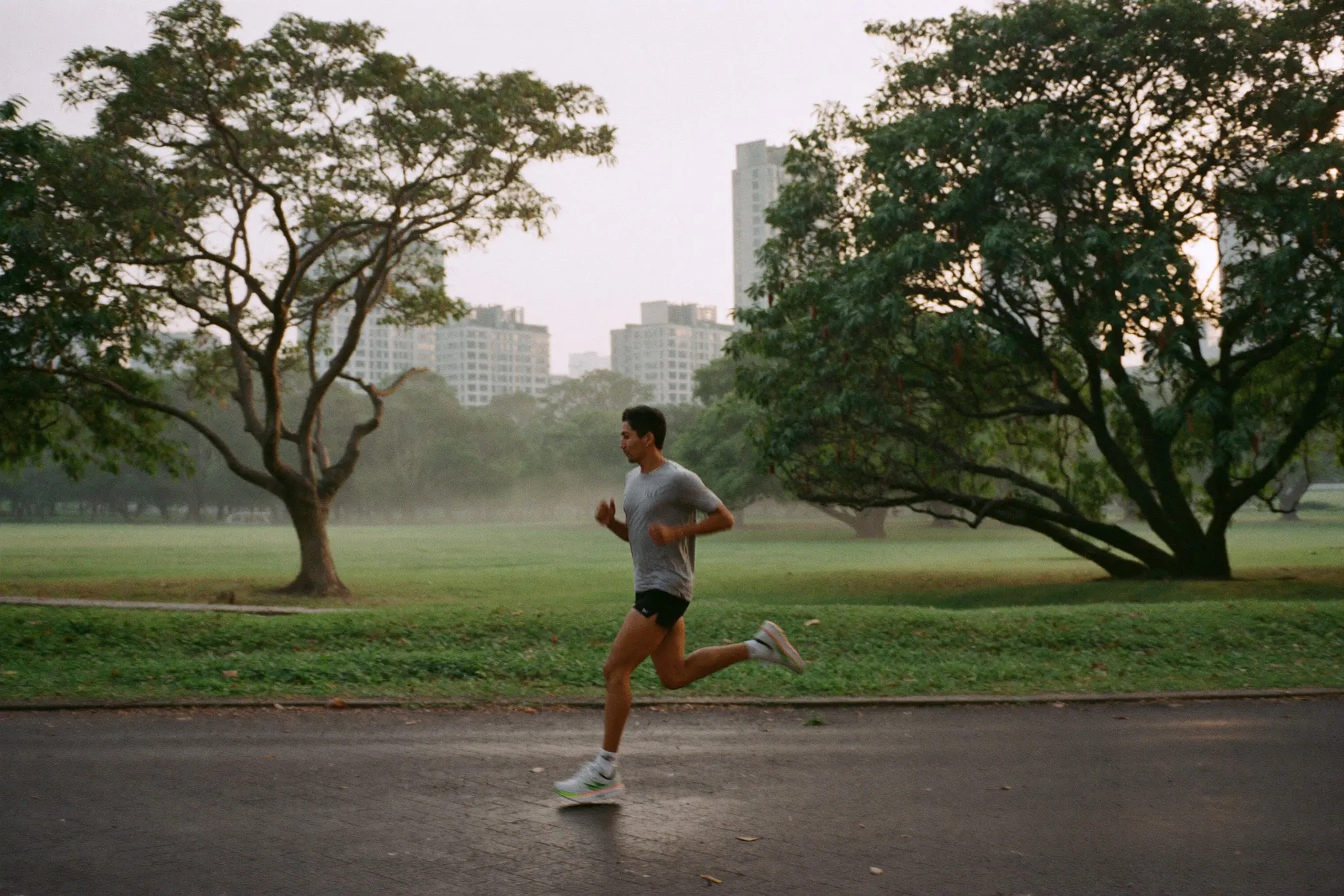
Start with run/walk intervals instead of trying to run the whole way, and go out before 7:30am or after 8pm. Keep the pace slow enough that you can still hold a conversation. Three sessions a week for eight weeks gets most beginners to a continuous 5K, and the heat here changes your schedule rather than your method.
What breaks the first attempt is rarely fitness. It’s choosing 6pm on a Tuesday in Cheras, setting off at a pace you saw someone else run, and finishing the first kilometre convinced something is wrong with your lungs. KL and Singapore sit around 30 to 33°C with humidity high enough that sweat stops evaporating properly, so your body cools badly and your heart rate climbs for the same effort. Plan around that and running here works fine.
When should you run in this climate?
Before 7:30am or after 8pm. Both windows cut the air temperature, take direct sun out of the equation, and let the pavement stop radiating heat back at you. Humidity stays high either way, but humidity alone is survivable. Humidity plus a 1pm sun is what sends beginners home walking.
Morning runs win on air quality and traffic. Roads are quieter, park connectors are half empty, and you finish before the day can talk you out of it. The cost is the alarm, and the first week of 5:50am feels absurd until it doesn’t.
Evening runs win on adherence, because most people are more willing to leave the house at 8:30pm than at 6am. You trade for mosquitoes near park water, poorer visibility on unlit stretches, and the fact that the ground is still giving back the afternoon’s heat until roughly 9pm.
One local variable overrides both: haze. Between roughly August and October, smoke from regional fires can push readings into the unhealthy band. Check the API in Malaysia or the PSI in Singapore before you go, and when either sits in that band, take the session to a treadmill instead. Running hard through smoke is a bad trade for a week-three beginner.
What does the first eight weeks look like?
Three sessions a week, roughly 30 minutes each, with the running portion growing and the walking portion shrinking. The structure below is the standard beginner progression. Repeat any week that felt hard rather than pushing on, and take a rest day between every session.
| Week | Session, 3x per week | Total |
|---|---|---|
| 1 | Run 1 min, walk 2 min, x8 | ~24 min |
| 2 | Run 90 sec, walk 2 min, x7 | ~25 min |
| 3 | Run 2 min, walk 90 sec, x7 | ~25 min |
| 4 | Run 3 min, walk 90 sec, x6 | ~27 min |
| 5 | Run 5 min, walk 2 min, x4 | ~28 min |
| 6 | Run 8 min, walk 2 min, x3 | 30 min |
| 7 | Run 12 min, walk 2 min, x2 | 28 min |
| 8 | Run 20 min continuous, walk 10 | 30 min |
Add five minutes of walking at each end. That’s your warm-up and your cool-down, and in this climate the cool-down matters more than most people credit. Walking the last five minutes lets your heart rate come down before you step into an aircon lobby.
The one rule that protects the whole plan: build total weekly time by no more than about 10% at a time. Your lungs adapt in weeks. Tendons and shins take months, and they are the ones that end beginner running careers.
How slow is slow enough?
Slow enough to speak a full sentence out loud without gasping between words. That’s the entire test, and it’s more reliable than any watch. If you can only manage two words at a time, you’re running at a pace your first eight weeks cannot support, and you’ll finish the session hating it.
Expect to be slower here than the numbers you see online. Heat and humidity add effort at any given pace, so a beginner in Bangsar or Tampines might run 30 to 60 seconds per kilometre slower than the same person in a cool climate, at the same heart rate. That gap is the weather, not you. It also means your pace improves noticeably in December when it rains more, which is a nice free win.
Do not calibrate against a friend’s Strava. Somebody’s 5:30/km is somebody else’s near-maximum, and comparing early is how people injure themselves in month one.
What kit do you need?
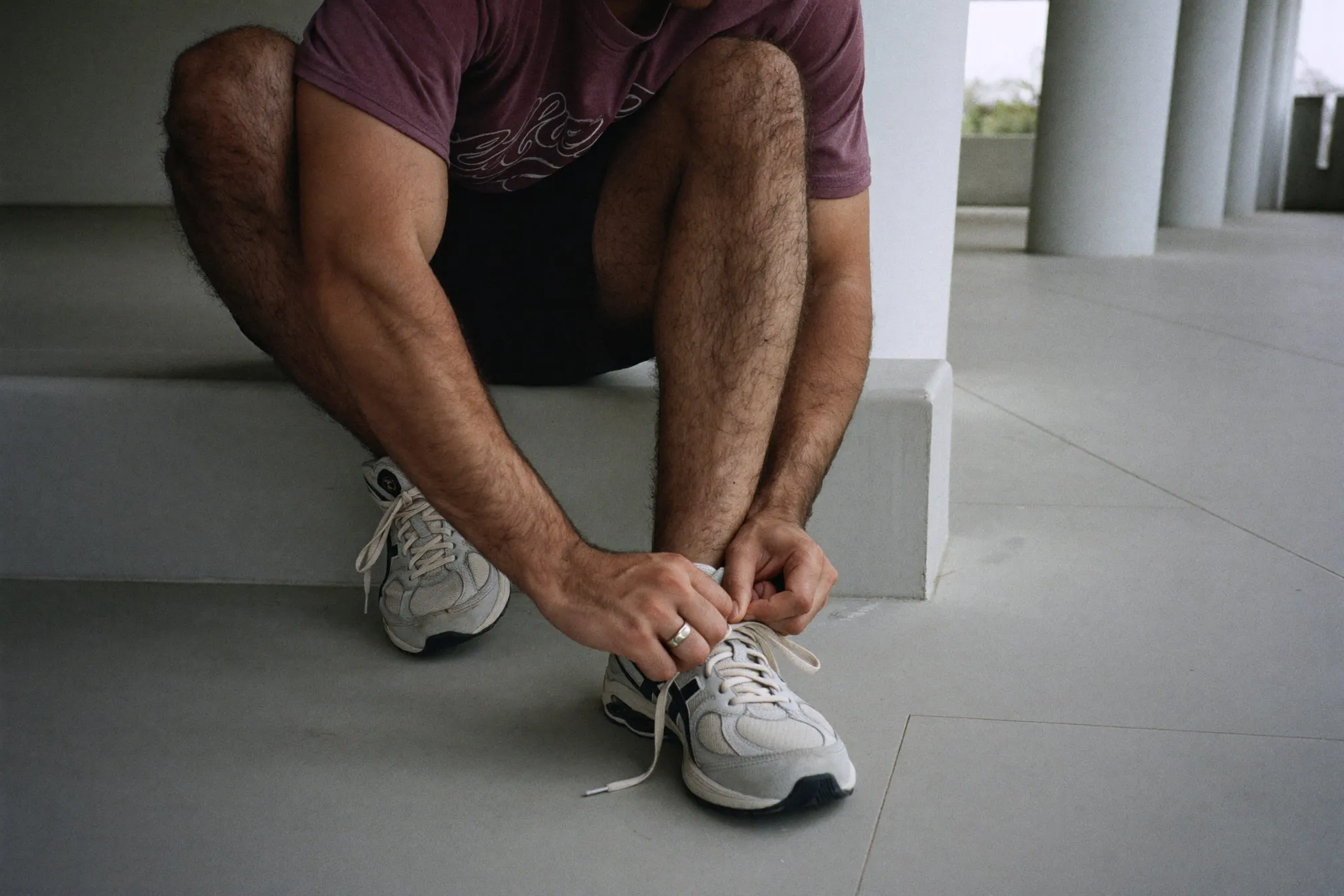
Shoes, socks that aren’t cotton, and something to stop chafing. Everything else is optional for the first two months. Beginners routinely spend RM800 on gear and RM0 on consistency, which is the wrong order.
| Item | Start here | Step up | Notes |
|---|---|---|---|
| Running shoes | Decathlon Kalenji, RM150-250 / S$60-90 | Fitted pair from a running store, RM450-750 | Half a size up, replace around 600-800km |
| Socks | Synthetic running socks, ~RM30 for three | Merino blend | Cotton socks cause blisters here, guaranteed |
| Top | Polyester tee or Uniqlo AIRism, RM30-60 | Technical singlet | Singlets chafe less than sleeves on a wet run |
| Shorts | Lined 5 to 7 inch shorts, RM50-100 | Split shorts | Liner beats separate underwear |
| Anti-chafe | Petroleum jelly, ~RM10 | Balm stick from Watsons or Guardian, RM35-50 | Nipples, inner thighs, under the arms |
For morning runs, add a cap and sunscreen. Sun exposure at 7am near the equator still counts, and it’s the cheapest damage to prevent. Our guide to sunscreen in this climate covers what survives sweat.
You’ll also sweat more than you expect in the hour after you stop. If your run sits in the middle of your day, read our deodorant guide before you assume a rinse fixes it.
Skip the watch, the gels, and the compression sleeves. A free phone app tracking time is enough to run the plan above.
Where do you run in KL and Singapore?
Parks and park connectors, not roads. Suburban Malaysian pavements disappear without warning, and dodging a parked car at 6am in low light is how ankles go.
Klang Valley. Perdana Botanical Gardens and Taman Tugu give you shade and soft-ish surfaces close to the city. Desa ParkCity and Taman Rimba Kiara suit PJ and Kepong runners. KLCC Park’s loop runs roughly 1.3km, which makes counting laps easy, and Bukit Jalil’s park is the pick if you’re south of the city. Padang Merbok early on a Sunday is quieter than you’d guess.
Singapore. The park connector network means most HDB estates have a route within ten minutes of the block. East Coast Park is flat and long, Bishan-Ang Mo Kio Park is the pleasant middle option, and MacRitchie’s trails are better saved for month three. Many ActiveSG stadium tracks are open to the public, and a 400m track removes every excuse about distance measurement.
Indoors. A condo or gym treadmill is a legitimate option on haze days and during a downpour. Set the incline to 1% so the effort matches outdoor running, and accept that it will feel more boring than it is hard.
How do you avoid the usual beginner injuries?
Shin splints, sore knees, blisters and chafing account for most early dropouts, and all four come from doing too much too soon. The walk intervals are the injury prevention, not a sign of weakness. Rest days between runs are where the adaptation happens.
Watch for shin pain that shows up earlier in each successive run. That’s the warning sign, and the response is to cut back a week and repeat it rather than run through it. Persistent knee or shin pain that doesn’t settle with a week of easy walking is worth a GP or physio visit.
Heat needs its own attention. If you get dizzy, stop sweating, feel nauseous, get a pounding headache or start cramping, stop the session, walk into shade and get fluids into you. If it doesn’t settle quickly, see a doctor. That’s not a common outcome for a 25-minute morning run, but it’s a real one for anyone attempting midday heroics.
On hydration, drink to thirst and stop guessing. For sessions under 40 minutes in the cooler hours, most people don’t need to carry water, though a small bottle on a humid evening costs you nothing. Drink a glass before you leave and a glass after.
Will running make you lean?
Running builds the engine, but food decides the waistline. Three 30-minute sessions a week burn less than most people assume, and hunger tends to rise to meet the effort. You’ll get fitter within a month and see the body composition change over a longer horizon, if the eating cooperates. Our piece on losing belly fat around real meals here handles that side properly.
What running does reliably in eight weeks: lower resting heart rate, better sleep, and stairs that stop registering. Those arrive well before any visible change, which is worth knowing so you don’t quit in week five looking for the wrong evidence. More options for building the rest of it sit in our fitness section.
Open your calendar now and block three 30-minute slots next week, before 7:30am or after 8pm, with a rest day between each. Tomorrow, walk five minutes from your door, then run one minute and walk two, eight times. That’s week one done in 24 minutes, and you’ll have started the only part of this that most people never do.
Quick answers
How long should a beginner run for?
Around 25 to 30 minutes per session, but most of that is walking at first. A run/walk structure of one minute running and two minutes walking, repeated eight times, is a full session in week one. You extend the running portion each week and keep the total time steady.
Is it too hot to run in Malaysia and Singapore?
No, if you pick your hour. Before 7:30am and after 8pm both drop the temperature and remove direct sun, which is the part that punishes you. Midday runs are the ones that end badly. On haze days, when the API or PSI reads unhealthy, move the session indoors.
How many times a week should a beginner run?
Three, with a rest day between each. Three sessions give your legs enough stimulus to adapt and enough recovery to avoid shin splints, which is the injury that ends most first attempts. A fourth run adds risk before it adds fitness in your first two months.
Do I need expensive running shoes to start?
No. A Decathlon cushioned running shoe at RM150 to RM250 or around S$60 to S$90 handles a beginner's mileage without complaint. Buy proper running shoes rather than gym trainers, get half a size up from your usual, and spend the money on a fitting later if you keep going.