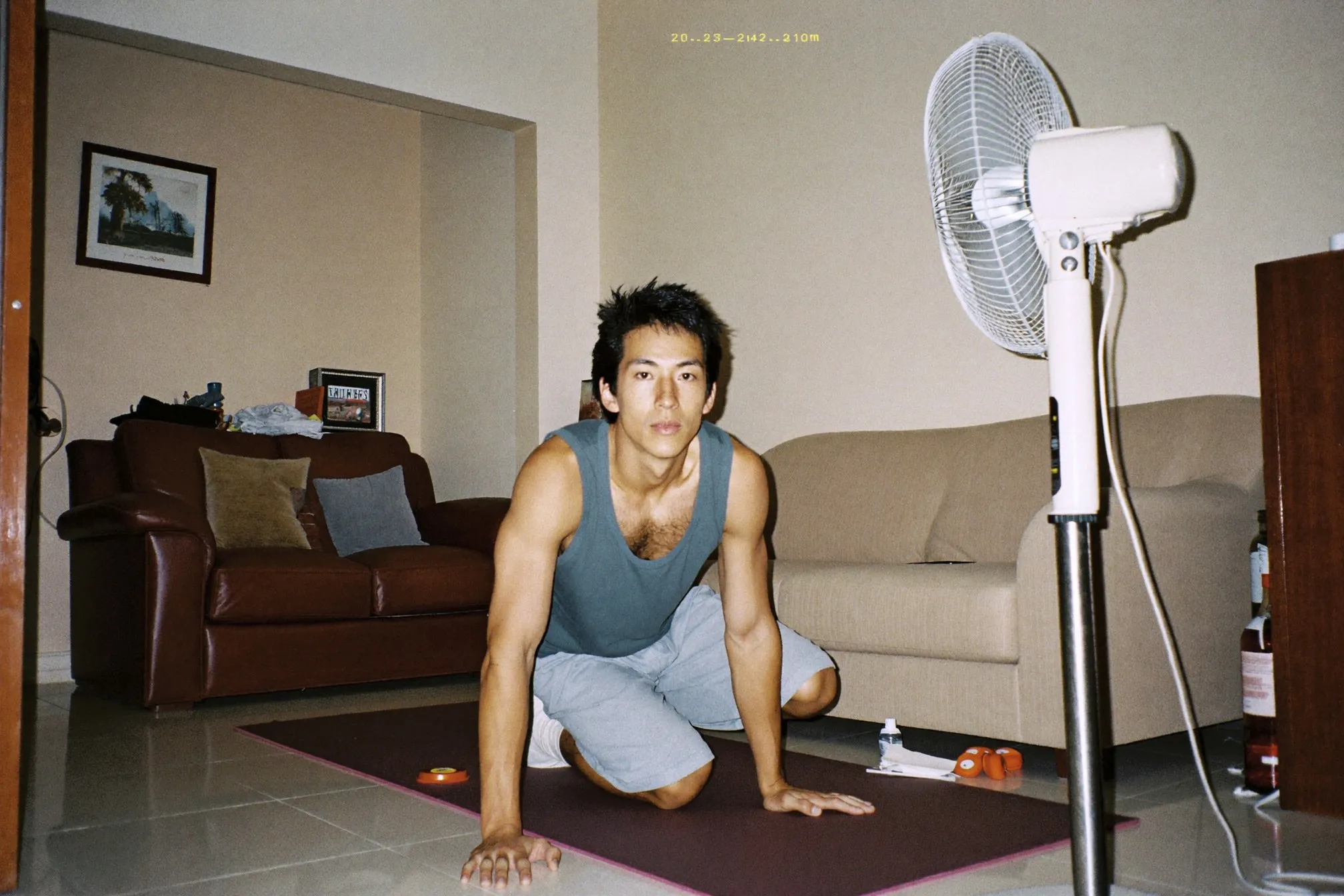
A HIIT workout at home means short bursts of near-maximum effort separated by short rests, repeated for 15 to 25 minutes on a patch of floor about the size of a yoga mat. Twenty minutes, two or three times a week, is the whole prescription. No equipment, no gym membership, no queue for the squat rack at 7pm.
The catch is that most of what circulates under the HIIT label is a 45-minute circuit class with the word bolted on. Real intervals are short, ugly and hard to fake. What follows is the version that fits a PJ condo living room, a HDB bedroom and a downstairs neighbour who works nights.
What counts as a HIIT workout at home?
Intensity defines it, not the exercises. You work hard enough that holding the pace past about 40 seconds becomes impossible, you rest until you can go hard again, then you repeat. If you could carry a phone conversation through the working set, you are doing circuit training. Useful, but a different thing.
The practical test: at the end of the third round you should be breathing through your mouth and counting down the seconds. At the end of the last round you should need a minute before you feel like standing up straight. That is the whole quality-control system, and it does not require a heart rate strap.
Two other markers separate HIIT from a general home workout. Sessions stay short, because you cannot generate that output for long. And the rest periods are part of the programme rather than dead time. Cutting your rest to look tougher lowers the intensity of the next set, which defeats the point.

Which interval format should you use?
Pick one format and run it for a month before switching. The differences matter less than showing up, but some ratios suit beginners far better than the ones fitness apps default to.
| Format | Work / rest | Rounds | Best for |
|---|---|---|---|
| Beginner intervals | 20s / 40s | 8 to 10 | First six weeks, poor conditioning |
| Even splits | 30s / 30s | 10 to 12 | General fitness once 20/40 feels easy |
| Tabata | 20s / 10s | 8 (4 min) | One movement, brutal, use as a finisher |
| Long intervals | 40s / 20s | 8 | Conditioning for runners and footballers |
| EMOM | 15 reps, rest the remainder of the minute | 10 to 15 | Self-pacing, easy to track |
Tabata gets quoted constantly and misused just as often. Four minutes of genuine Tabata means one exercise, all-out, with 10 seconds of rest. It is a finisher, not a workout. If you finish eight rounds feeling fine, you were not working at the required effort.
EMOM (every minute on the minute) suits anyone who hates counting seconds. Set a repeating one-minute timer, do your reps, rest whatever remains. As you get fitter the reps take less time and your rest grows, which tells you the fitness is improving without any maths.
What does a beginner HIIT session look like?
Here is a full 20 minute workout that needs no equipment and no jumping. Warm up for three minutes: marching on the spot, arm circles, ten slow bodyweight squats, ten shoulder rolls. Skipping this in a hot flat feels reasonable and is how people tweak knees.
Then run four exercises for 20 seconds of work and 40 seconds of rest, three times through:
- Squat to stand-up. Fast down, fast up, heels planted. Count reps and try to beat the number next round.
- Push-ups, hands elevated on a chair or the sofa arm. Elevation makes them easier, which lets you keep the speed high. Drop to the floor only when a set of 12 stops being a struggle.
- Reverse lunges, alternating. Step back rather than forward. Kinder on the knees and quieter on tiles.
- Mountain climbers. Hands under shoulders, hips low, knees driving. This is the one that ends the debate about whether you are working hard.
Twelve minutes of intervals, three of warm-up, two of walking around the flat afterwards until your breathing settles. Nineteen minutes, and the only equipment involved is a chair.
Once that stops hurting, move to 30 seconds on and 30 off, then add a fourth round. Progression in HIIT comes from more work per interval or more rounds, not from adding exercises. A ten-move circuit is a different animal, and usually a slower one.
How do you do this without annoying the neighbours?
Jumping is the problem, not effort. High-rise floors in both countries transmit impact straight down, and a burpee at 6.30am carries further than you think. The fix is picking movements that generate intensity through speed and range rather than through landing.
Quiet substitutions that keep the intensity:
- Skater steps instead of jump squats. Push laterally, land on one foot, absorb through the hip.
- Fast step-backs instead of jumping lunges.
- Half-burpees (walk the feet out, walk them back, no jump) instead of full burpees.
- Bear crawl on the spot instead of high knees. Miserable, silent, effective.
- Isometric holds under time pressure such as a wall sit or a plank with shoulder taps, both of which spike your heart rate without a single foot leaving the ground.
A cheap mat helps more than it sounds. Around RM40 to RM70 at Decathlon or on Shopee gets you 10mm of foam that kills most of the noise and saves your wrists on tile. If your building has a void deck, an open-air fitness corner or a stairwell landing nobody uses, that solves the problem outright at 7am.

How do you survive high intensity training in 33°C?
Heat is the reason most home HIIT attempts here die in week two. Your body loses a large share of its cooling capacity when the air is already 30°C at 85% humidity, so a session that feels moderate in an aircon gym feels like drowning in a Bangsar walk-up at 4pm.
What works:
Train early or late. Between 7am and 8.30am, or after 8pm. The gap between a 7am and a 3pm session in an unaired flat is enormous.
Point a fan at yourself, not at the room. Moving air over wet skin is how sweat actually cools you. A standing fan on your torso at close range changes the session more than any supplement you will ever buy.
Drink before, not just after. Half a litre in the 30 minutes before you start. Add a pinch of salt to a bottle if your shirt dries white and stiff, which means you are a heavy salt sweater.
Extend the rest, keep the effort. In hot weather, take 45 seconds instead of 30 and go harder in the work phase. Intensity is the ingredient. Density is negotiable.
Stop for real warning signs. Dizziness, a headache that arrives mid-session, chills or goosebumps in the heat, or nausea mean you stop and cool down rather than push through. If those keep happening at moderate effort, or you have a heart condition or high blood pressure, talk to a GP before you keep going.
How does HIIT fit with lifting and running?
Two or three HIIT sessions a week is the ceiling for most people, and two is the sensible default once you are also doing anything else. HIIT recruits your nervous system hard, and the fatigue shows up in your leg strength and your sprint speed days later rather than the next morning.
| Your main goal | HIIT per week | Where it goes |
|---|---|---|
| General fitness, no other training | 3 | Mon / Wed / Fri, non-consecutive |
| Building muscle | 1 to 2 | After lifting, or on a rest day, never before leg day |
| Running | 1 | Replace one easy run, not the long one |
| Fat loss | 2 to 3 | Alongside walking and a food plan that does the real work |
The most common mistake in that table is the fat loss row. HIIT burns a respectable number of calories for the time spent, and it improves how you handle effort, but 20 minutes of intervals does not out-earn a week of eating on autopilot. Treat the training and the eating as two separate projects.
Which mistakes make home HIIT useless?
- Going at 70% for the whole session. The intensity is the entire mechanism. A comfortable interval workout is just a slow circuit.
- Adding exercises instead of effort. Four movements done hard beats ten done vaguely.
- Skipping the warm-up on cold mornings. Three minutes. Your knees will collect on this debt eventually.
- Doing it daily. Five sessions a week means each one is soft. Two hard ones move you further.
- No record. Write the round count in your phone notes. Beating last week’s number is the only progression HIIT offers you.
Pick one 20-minute slot in the next two days, set a repeating 20-on-40-off timer on your phone, and run the four-exercise session above. If you want the full picture on training at home, the wider fitness guides cover the strength side that intervals do not touch.
Quick answers
How long should a HIIT workout at home be?
Fifteen to twenty-five minutes including the warm-up. If you can hold your pace for thirty minutes, the intensity is too low to count as HIIT. Two hard sessions a week beats five half-hearted ones, and a 20 minute workout is short enough that you stop negotiating with yourself about it.
Is HIIT good for beginners?
Yes, with two adjustments. Start at 20 seconds of work and 40 seconds of rest instead of the even splits you see online, and pick movements you can already do slowly with control. Squats and step-backs before burpees. Build the engine first, add the jumping later.
Can you lose belly fat with HIIT alone?
HIIT burns calories and improves conditioning, but body fat comes off through the food you eat across the whole week. Training three times a week and eating the same as before rarely moves the number. Use HIIT for fitness and time efficiency, and handle the eating separately.
How many times a week should you do HIIT?
Two or three sessions on non-consecutive days. HIIT taxes your nervous system as well as your muscles, so daily sessions turn into slow-motion cardio within a fortnight. If you also lift or run, cap HIIT at two and keep the hard days apart.