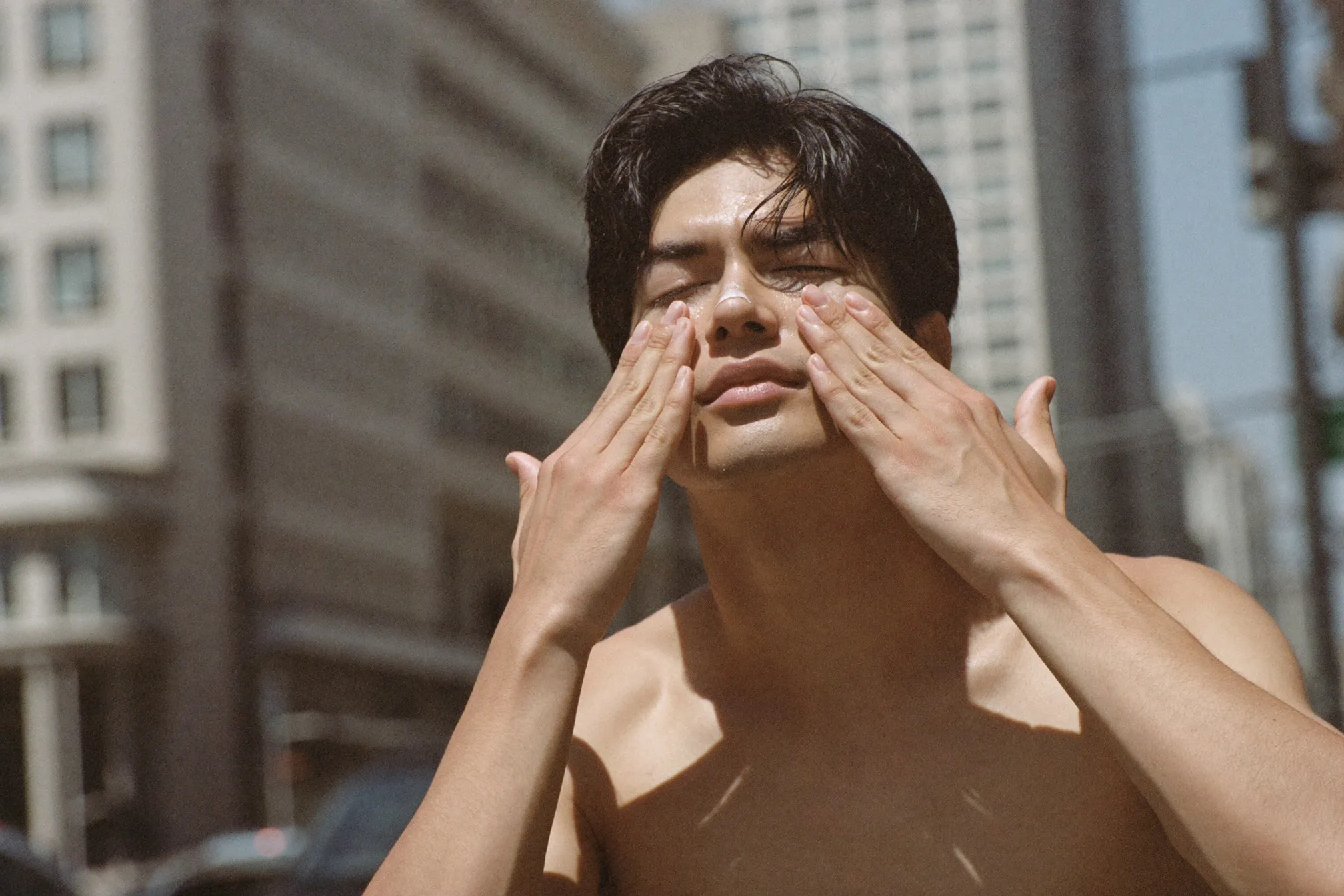
You need SPF 30 or higher, broad spectrum, applied every morning you leave the house. That’s the whole rule, and it comes straight from the American Academy of Dermatology. Living three degrees off the equator, where the UV index hits “very high” on an average Tuesday, SPF 50 buys you extra margin.
Most men here still skip it. The usual reasons: it feels greasy, it stings the eyes at the mamak, it seems pointless when you’re indoors by 9am. Every one of those has a fix, and none of the fixes costs more than RM60.
Why bother when you barely see the sun?
The sun you don’t feel still reaches you. UVA rays penetrate cloud and window glass, and they do the slow damage: sagging, uneven tone, the leathery texture you see on lifelong drivers, and their share of skin cancer risk. The WHO classifies ultraviolet radiation as a carcinogen. Skin cancer rates run lower for Asian skin than for fair skin, but “lower” is doing quiet work in that sentence. The damage that shows up as ageing happens to everyone.
Here’s the part that changes behaviour: UVA exposure is roughly constant through daylight hours. Your 8am commute and your 1pm chicken rice run both count. A KL-to-Penang drive counts double, on the right side of your face.

What do the labels actually mean?
Four things matter on a bottle sold in MY or SG:
| Label | What it tells you | What you want |
|---|---|---|
| SPF | UVB (burning) protection | 30 minimum, 50 for outdoors |
| PA+ to PA++++ | UVA (ageing) protection, Asian rating system | PA+++ or more |
| “Broad spectrum” | Covers UVA and UVB | Required |
| “Non-comedogenic” | Formulated to not clog pores | Required if you break out |
Ignore “waterproof” claims. Regulators in most markets only allow “water resistant” with a stated duration, and sweat defeats everything eventually. Reapplication beats marketing.
Which type suits your skin?
Oily skin, which is most of us here. Gel and “watery” fluid textures. Japanese daily sunscreens built for humid summers disappear in seconds and leave a matte-ish finish. Expect RM40 to RM60 at Watsons or Guardian, less during Shopee sales.
Dry or aircon-wrecked skin. Milk or lotion textures with glycerin or hyaluronic acid. You get light moisturisation and SPF in one step.
Sensitive skin or stinging eyes. Mineral formulas that use zinc oxide or titanium dioxide. They sting less near the eyes than chemical filters. The trade-off is a slight white cast, more visible on deeper skin tones, so test before you commit. Newer hybrid formulas cut the cast substantially.
Acne-prone skin. Non-comedogenic gel formulas, and wash your face properly at night. Sunscreen left on overnight causes more breakouts than sunscreen itself ever did.
How much, and how often?
The dermatology standard is about a teaspoon for face and neck. In practice: two finger-lengths of product, first line from knuckle to fingertip on your index and middle fingers. Apply it as the last step before you leave, on top of moisturiser if you use one.
Reapply every two hours of direct sun exposure, per the AAD. For a desk job, one honest morning application covers you. For futsal, a hike or a day at Sentosa, bring the bottle and use it. A sweat-heavy hour outdoors ends any sunscreen’s shift early.

A routine that survives real life
The routine that fails is the one with six steps. This one has two:
- Morning, after washing your face: two fingers of gel sunscreen. Thirty seconds, including the part where you rub it into your hairline.
- Nights you remember: wash it off with a proper cleanser rather than bar soap.
That’s it. Add moisturiser underneath if your skin runs dry. Upgrade to reapplication on outdoor days. Anything beyond that belongs to skincare hobbyists, and we say that with respect, because some of us are those hobbyists.
One honest caveat: if you have a mole that’s changing, patches that won’t heal, or any skin concern beyond oil and the occasional breakout, see a GP or dermatologist. A RM50 bottle solves prevention. It doesn’t diagnose anything.
Start tomorrow morning. Your 45-year-old face is the one collecting the interest.
Quick answers
What SPF should I use in Malaysia or Singapore?
Dermatology bodies recommend SPF 30 or higher with broad-spectrum protection. Near the equator, the UV index sits in the very high range most days, so SPF 50 gives you more margin for thin application and sweat.
Do I need sunscreen if I'm indoors or driving all day?
UVA passes through glass, so a window seat or a long drive still exposes you. If your day includes a commute, lunch outside or a desk by the window, a morning application is worth it.
Why does sunscreen make my face oily?
Heavier cream formulas add oil your skin doesn't need in this climate. Switch to a gel or fluid labelled non-comedogenic. Japanese and Korean daily sunscreens are built for humid weather and sit far lighter.
Is a moisturiser with SPF enough?
Only if you apply as much as you would a dedicated sunscreen, which almost nobody does. Most men apply a thin layer of SPF moisturiser and get a fraction of the labelled protection. A separate sunscreen is the more honest option.