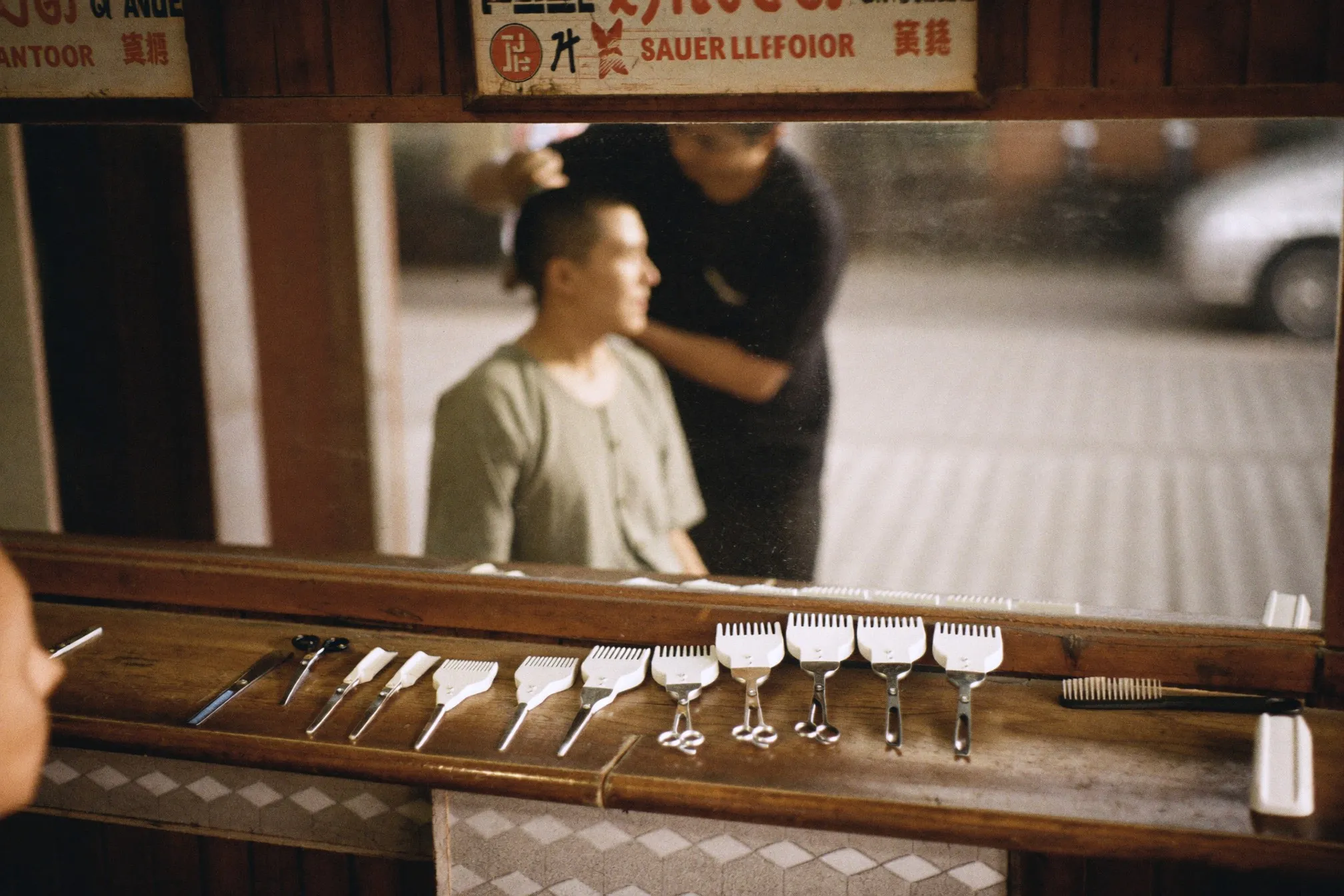
Most men’s haircut names describe three decisions: how short the sides go, how long the top stays, and what the front does. Once you can name those three, the whole dictionary below stops being jargon. A fade is a side treatment. A crop is a top. A two block is both at once.
That is why “I want a fade” gets you a different cut in Cheras than it does in Tiong Bahru. The word covers a family, not a style. Below is every cut you will meet in a Malaysian or Singaporean barbershop, defined in plain terms.
How do haircut names work?
A haircut name is shorthand for a combination, not a single fixed style. Some names describe the sides (fade, taper, undercut). Some describe the top (crop, quiff, pompadour). A few describe the join between them. You stack them freely, which is why “mid fade with a textured crop” is one haircut carrying two names.
Every cut in this dictionary is built from three choices:
| Decision | Options | What it changes |
|---|---|---|
| Sides | Taper, fade (low, mid, high), undercut, one-length scissor cut | How sharp it looks and how often you sit in the chair |
| Top | Buzz, crop, mid-length, long | How many minutes you spend on it each morning |
| Front | Fringe forward, swept back, side part, middle part | How your face shape reads |
Get those three right and the name barely matters.
What are the fade cuts?
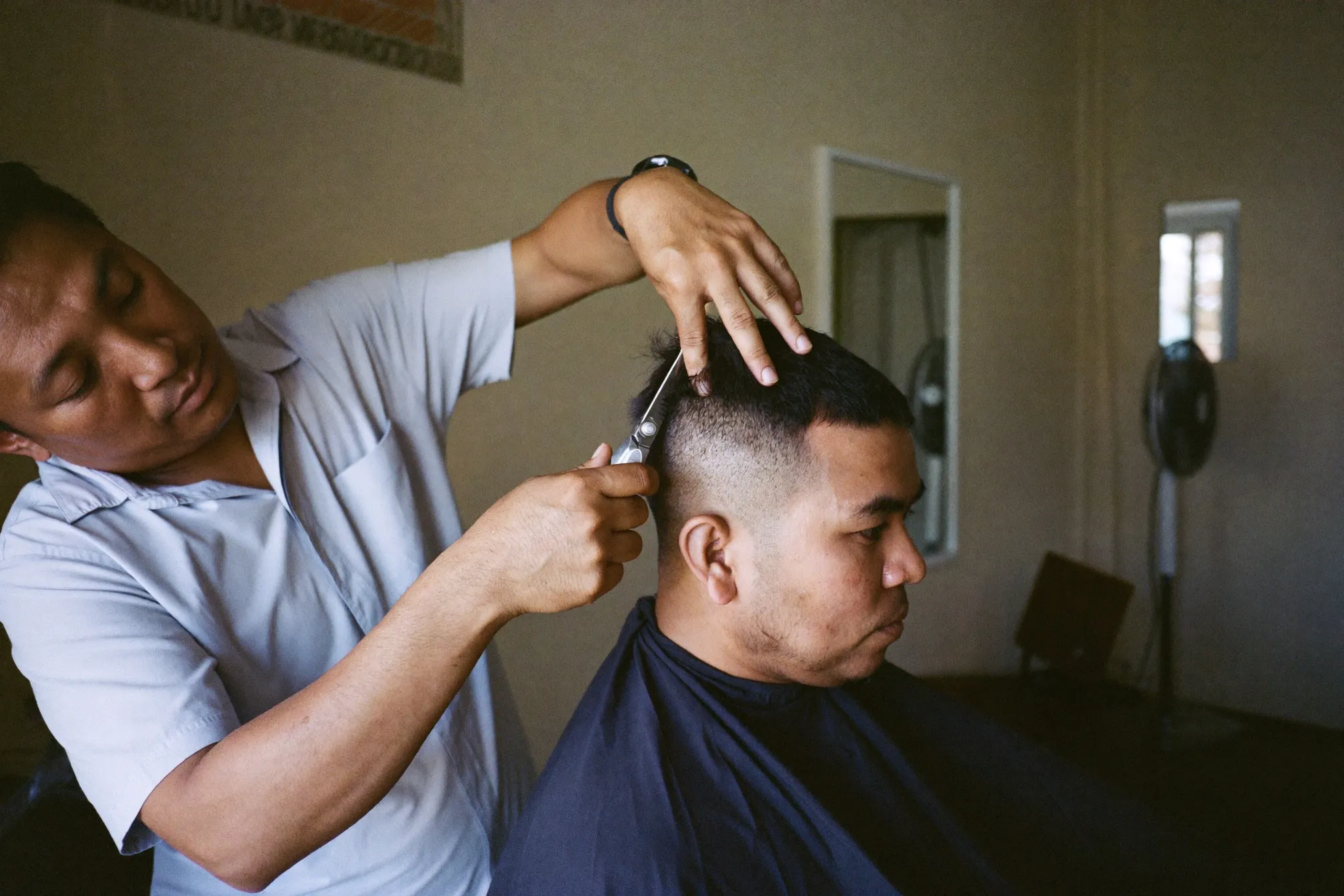
A fade blends the back and sides from very short, sometimes bare skin, up to longer hair on top with no visible line where the lengths meet. The name tells you where the blend starts and how high it climbs. It says nothing about the top, which is a separate conversation.
- Taper. Not a fade. Only the sideburns and the neckline get shortened, and the sides stay one length. The most office-proof option in this list.
- Low fade. The blend starts about a finger’s width above the ear and stays below the temple. Conservative, and it grows out gracefully.
- Mid fade. Starts at the temple. The default request in most KL and Singapore shops, and the one that flatters the widest range of head shapes.
- High fade. Starts near the top corner of the head. Bold, and it exposes a lot of scalp on thin hair.
- Skin fade (bald fade). The bottom goes to razor-bare skin. Sharpest finish, shortest shelf life, and it needs a barber every two weeks.
- Drop fade. The fade line curves down behind the ear instead of running straight. It follows the skull, so it suits round heads.
- Burst fade. A semicircle of fade around the ear only, leaving the back long. The mullet’s usual partner.
- Temple fade (temp fade). Only the corners at the temples get cleaned up. A touch-up, not a haircut.
- Shadow fade. A fade that never reaches skin, stopping at a grade 1 or 2. Softer, and it hides scars and uneven scalp tone.
Our fade haircut guide covers the heights, the grade numbers and what each version should cost.
What are the short crop cuts?
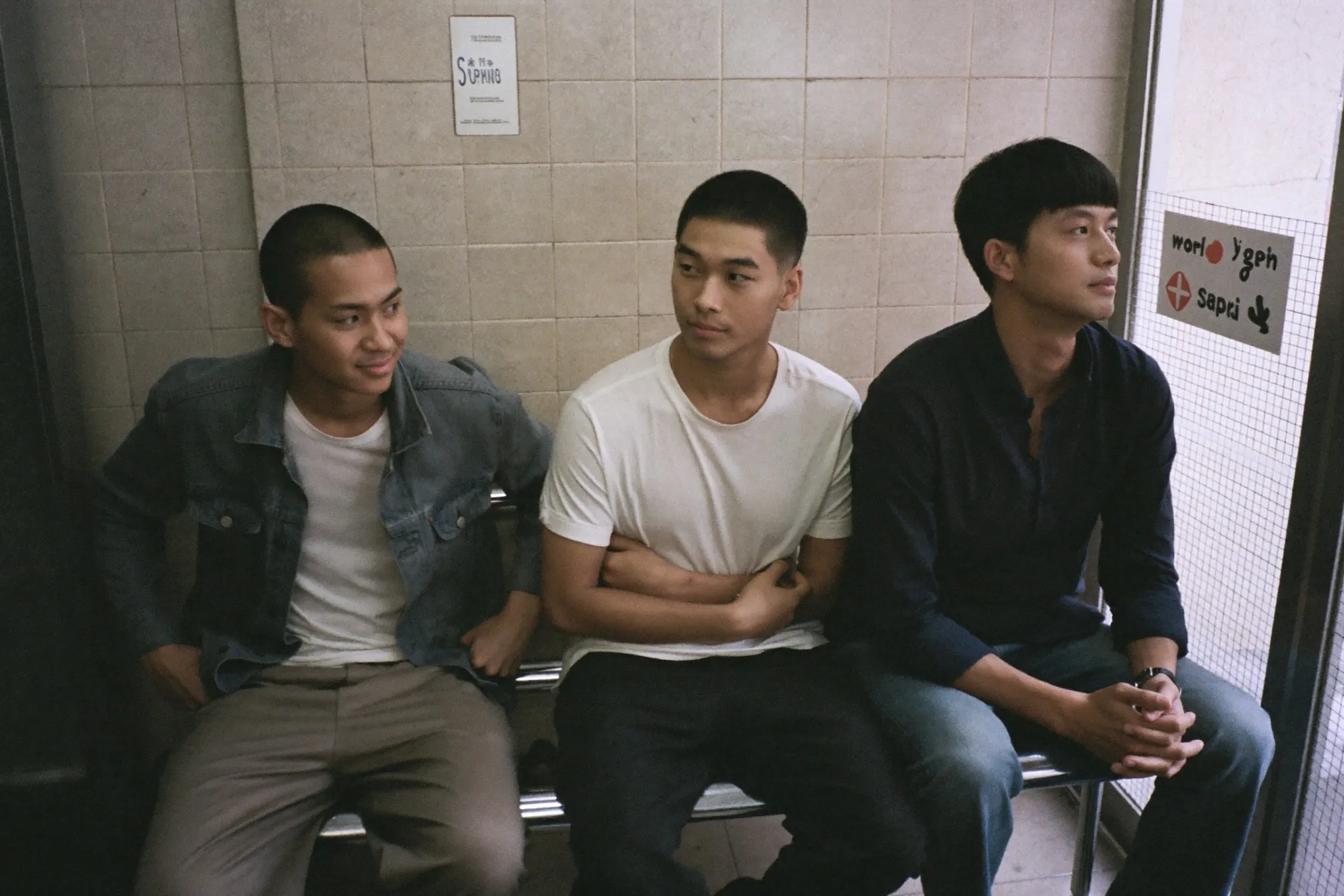
These are the cuts where the top is short enough to need little or no product. They differ by a centimetre here and a fringe shape there, which sounds trivial until you see two of them side by side. Barbers charge the same for all of them.
- Buzz cut. One clipper grade over the whole head. Grade 1 is close to shaved, grade 4 is about a centimetre. Add a taper at the neckline and it stops looking like a punishment.
- Induction cut. Grade 0 everywhere. Army intake, no blending.
- Crew cut. Short sides, slightly longer at the front, tapered from front to back. The 1950s office standard, and it has never left.
- Ivy League. A crew cut with enough length at the front to hold a side part. Also called the Harvard clip. Reads formal without reading old.
- French crop. Short sides with a blunt fringe cut straight across the forehead. Excellent on receding hairlines, since the fringe covers the corners.
- Textured crop. The French crop’s messier cousin. The fringe is point-cut so it sits in separated pieces rather than a flat line. This is the cut you keep seeing on men in their twenties from Bangsar to Bugis.
- Caesar. A crop with the fringe combed forward and cut short and straight, higher on the forehead.
- High and tight. Very short sides with a small island of length on top. Military, and unforgiving on anyone whose skull has opinions.
What are the disconnected cuts?
Disconnected means there is no blend. The sides stay one length, the top stays another, and the two lengths meet in a visible step. The effect is graphic rather than soft, and it is the defining look of the last decade of Asian men’s hair.
- Undercut. Sides clipped to one uniform length, top left long and dropping over them. No gradient anywhere.
- Disconnected undercut. The same, exaggerated. A dramatic step between a very short side and a long top, usually slicked back.
- Two block. The Korean version: the underneath section is clipped short, the top section is scissor-cut and left long enough to fall over the join and hide it. Softer than an undercut, and it removes side bulk from thick hair without looking severe.
- Mullet. Short at the front and sides, long at the back. The line between the two is the whole point.
- Modern mullet. The current interpretation. Shorter and more blended at the back, often paired with a burst fade, closer to a long shag than to 1985.
- Wolf cut. A shag and a mullet crossed. Heavy layers through the crown, wispy ends, length at the back and the sides.
The two block haircut guide explains how to keep the join from looking like a helmet. If the back length tempts you, read the modern mullet guide first. The gap between wearable and regrettable is about four centimetres.
What are the styled-on-top cuts?
These names describe the top and the front, and they all assume you own product and will use it. Most take between one and three minutes each morning. The sides underneath can be a fade, a taper or an undercut, which is how you end up with names like “low fade pompadour”.
- Pompadour. Volume swept up and back from the forehead, the height concentrated at the front. Needs length, and it needs a blow dryer.
- Quiff. A shorter, messier pompadour. The front lifts, the rest lies down. More forgiving than it looks.
- Slick back. Everything combed straight back, flat to the head. Works on straight hair, fights you on wavy.
- Side part. A defined parting, hair combed to one side. Barbers can cut a natural part in so it falls the same way every morning.
- Comb over. A soft side part with the hair swept across rather than parted hard. Nothing to do with the bald-man version of the term.
- Curtains. Mid-length hair parted in the middle, falling either side of the forehead. Back from the nineties and holding.
- Comma hair. The Korean signature: a fringe curved forward and inward so it hooks like a comma across the forehead. Half haircut, half styling technique.
- Man bun and top knot. Long enough to tie. The top knot keeps short or faded sides and gathers only the top.
- Shag. Heavy layering throughout for movement, mid-length, deliberately undone.
Korean hairstyles for men breaks down comma hair and curtain fringes for hair that has to survive ninety percent humidity by 10am.
What do perms and texture services add?
A perm chemically changes the hair’s shape so it holds a curve without daily styling. In Malaysia and Singapore it is a mainstream men’s service, not a niche one, and it exists mostly to solve two local problems: hair that sticks out sideways, and hair that goes flat by noon.
- Down perm. Presses the sides flat instead of curling them. The single most common men’s perm in the region, and it makes thick hair sit rather than flare.
- Root perm (volume perm). Curls only the first few centimetres at the roots to lift flat hair off the scalp.
- Side perm or comma perm. Sets the fringe into a forward hook so comma hair holds without a dryer.
- Digital perm. Heated rods create a looser, larger wave that shows up more when the hair is dry. Common on mid-length styles.
- Wolf perm. A wolf cut with waves permed through the length.
Expect roughly RM150 to RM400 in Klang Valley salons and S$80 to S$200 in Singapore. If your hair is already curly you have the opposite problem, and the curly hair guide for Asian men covers managing volume rather than adding it.
Which cut suits your hair type?
Hair type decides more than face shape does. Thick straight hair grows outward and needs weight removed. Fine hair needs weight kept. Wavy hair needs length to settle. Choose against your hair type and you will fight it every morning for six weeks.
| Hair type | Works well | Fights you |
|---|---|---|
| Thick and straight | Two block, textured crop, mid fade, down perm | Slick back, long curtains |
| Fine or thinning | French crop, buzz cut, Caesar, shadow fade | High fade, pompadour, slick back |
| Wavy | Mid-length shag, curtains, quiff, crew cut | Blunt French crop, skin fade |
| Curly or coily | High-top with a taper, curly crop, burst fade | Side part, comb over, straight blunt fringe |
| Receding hairline | French crop, buzz cut, textured crop | Slick back, pompadour, anything swept off the forehead |
What do you say at the chair?
Give the barber numbers, not names. Say the grade you want at the bottom, where the fade should start, how many centimetres stay on top, and what the fringe does. Then show two photos, one from the front and one from the back. Names travel badly between shops. Measurements do not.
A working script: “Grade 1 at the bottom, fade starting at the temple, about four centimetres on top, scissor-cut, fringe long enough to fall forward.” That gets you a mid fade textured crop in any shop in either country.
Prices run RM15 to RM40 at a neighbourhood barber in Malaysia and RM60 to RM120 at an appointment-only shop in Bangsar or TTDI. Singapore sits at S$12 to S$20 in HDB shops, S$35 to S$60 for boutique barbers. The cut is half the result, so read pomade, clay, wax or powder before you buy whatever is stacked by the till. More on care and hair loss in the hair section.
Open your camera roll tonight and pick two photos of hair you like, one front and one back. Write the three variables under them: side grade, top length, fringe direction. Bring that to your next appointment instead of a style name.
Quick answers
What is the most requested men's haircut in Malaysia and Singapore?
A mid fade with a textured crop on top. It suits thick straight hair, needs about a minute of styling, and every barber from an HDB shop to a Bangsar studio can cut one. The two block runs a close second, especially with men under thirty.
What is the difference between a fade and an undercut?
A fade blends gradually from short at the bottom to longer at the top with no visible line. An undercut skips the blend: the sides stay one short length and the top drops over them like a lid. Fades look softer, undercuts look sharper and grow out faster.
Which men's haircut needs the least maintenance?
A one-length buzz cut at grade 3 or 4. It has no fade to blur, no fringe to shape and no product to apply. You can stretch it to six or eight weeks, or run clippers over it yourself at home for the cost of a RM60 trimmer.
How do I ask for a haircut when I do not know the name?
Describe three things: how short the sides go, how much length stays on top, and what the front does. Bring two photos, one from the front and one from the back. Barbers work from photos and measurements far better than from style names they may define differently.