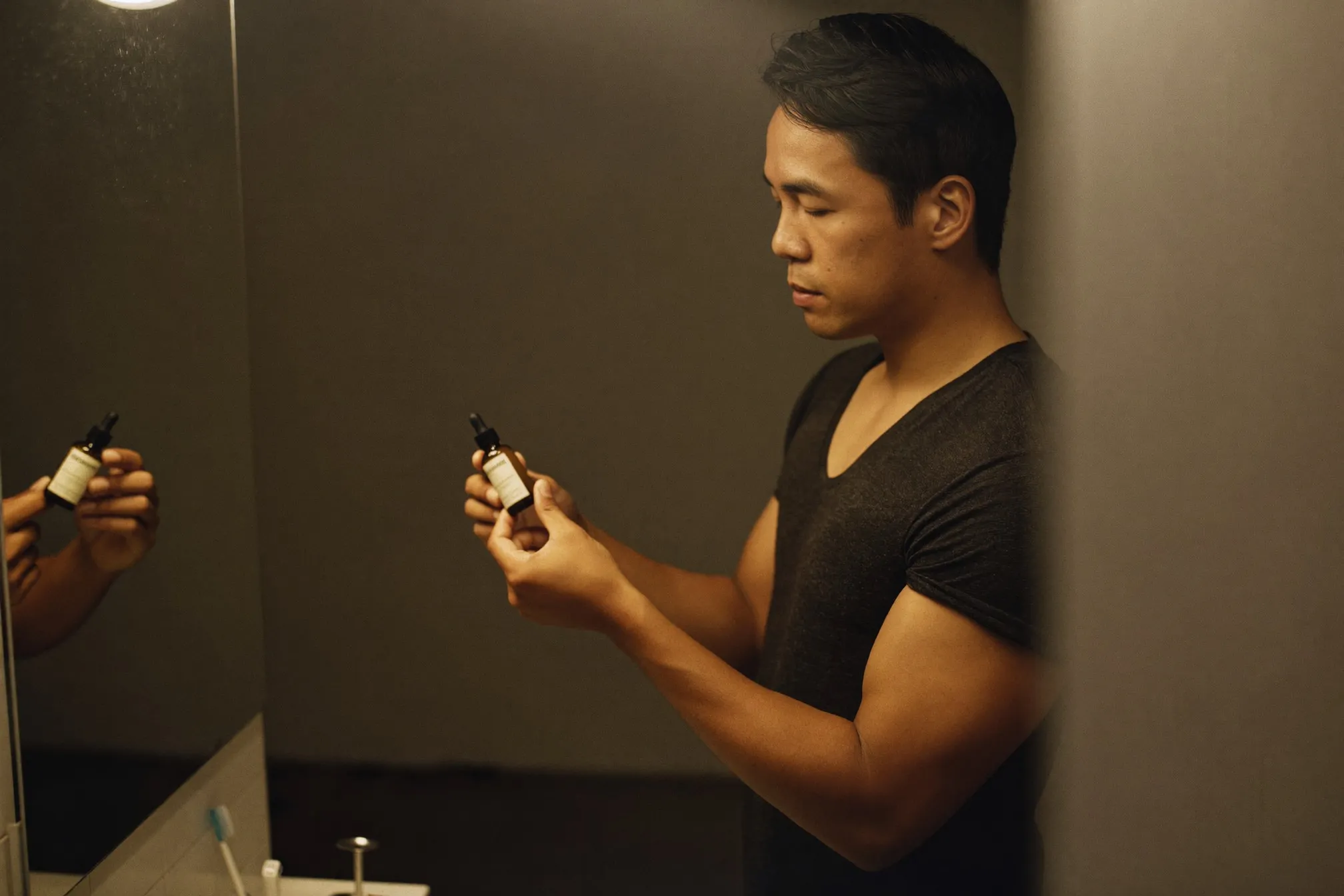
Three skincare actives are worth your money: niacinamide for oil and uneven tone, vitamin C in the morning, retinol at night for texture and fine lines. Add one at a time, give each about twelve weeks, and wear sunscreen over all of it. That is the entire strategy.
The rest of what you see on Shopee and TikTok is either one of those three in a nicer bottle, or a supporting ingredient sold as a headline. Prices swing from RM30 to RM300 for the same ingredient. Knowing which is which saves you a few hundred ringgit a year.
What counts as an active, and how many do you need?
An active is the ingredient with real evidence behind a specific change: less oil, fewer dark marks, smoother texture. Everything else in the bottle carries it, thickens it or makes it smell like a spa. Most men need one active at a time, layered onto a routine that already works.
That base routine is cleanser, moisturiser, sunscreen. If yours is not consistent yet, fix that before buying serums. Our three-step routine covers it in about ninety seconds a day, and the sunscreen guide explains why the last step is non-negotiable three degrees off the equator.
Adding one active at a time is not caution for its own sake. If you start three products on the same Monday and your face turns red on Thursday, you have no way of knowing which one did it. You end up binning all three, including the two that were fine.
What does niacinamide do?
Niacinamide is a form of vitamin B3, and it is the gentlest of the three. It is used in skincare for oil control, redness and uneven tone. Most skin tolerates it, it costs little, and it plays well with almost everything else on your shelf. If you are picking your first active, pick this one.
For men here, the oil angle does the heavy lifting. A face that shines by 11am in a KL office is responding to heat and humidity as much as to genetics, and niacinamide is one of the few ingredients that reliably takes the edge off without stripping your skin dry. Pair it with a proper approach to oily skin rather than expecting a serum to fix a habit problem.
Where it disappoints: it is slow on deep pigmentation and it will not touch a cystic breakout. Manage the expectation and you will be happy with it.

Is a vitamin C serum worth the price?
Vitamin C is an antioxidant used in the morning, under sunscreen. It may help with dull tone and the brown marks left behind by old spots. It is also the most fragile ingredient in your bathroom, which is where most of the money gets wasted.
The fragility is the whole story. Vitamin C oxidises with light, air and heat, and a bathroom in Petaling Jaya or an HDB flat in Tampines supplies all three generously. A serum that has turned dark orange or brown has passed its useful life, whatever the expiry date says. Buy it in an opaque or dark glass bottle, keep it in a cupboard rather than on the window ledge, and buy the smaller size so you finish it while it still works.
MedlinePlus describes vitamin C as an antioxidant the body needs, and eating it is straightforward. Rubbing it on your face is a cosmetic bet, not a medical one, and the honest position is that it may help some people modestly over months. Treat it as the optional member of the trio. If you are choosing between a vitamin C serum and a better sunscreen, buy the sunscreen. It is not a substitute for sun protection either, and the NHS is blunt about SPF doing that job.
If dark marks are your main complaint, they usually trace back to spots you picked. The acne guide deals with the cause, which beats treating the aftermath forever.
How do you start retinol without shredding your face?
Slowly. Buy the lowest strength you can find, use it two nights a week, apply moisturiser after it, and increase the frequency only once your skin stops complaining. Expect some dryness and flaking in the first few weeks. That phase settles for most people.
Retinol is a vitamin A derivative and the best evidenced of the three for texture and fine lines. It is also the one most likely to make you look worse before it makes you look better, mostly because men buy the strongest bottle on the shelf and use it nightly from day one. Do not do that.
Three rules that prevent the horror stories:
- Moisturiser after, every time. Some people go further and apply moisturiser before and after, which buffers the sting. Less irritation beats faster results.
- Nothing abrasive on retinol nights. No scrubs, no exfoliating acids, no aftershave that burns. Your skin is doing enough.
- Sunscreen every morning, without exceptions. Retinol can leave skin more sensitive to sunlight. Skipping SPF while using it defeats the purpose entirely.
Prescription-strength retinoids exist and outperform anything on a pharmacy shelf. Those come from a doctor after a consultation, not from a Shopee seller with a good rating. If your skin needs that level of help, book the appointment.
Which actives can you use together?
Layering rules are simpler than the internet suggests. Vitamin C goes in the morning, retinol goes at night, and niacinamide fits either slot. Exfoliating acids stay off retinol nights. Follow that grid and you avoid nearly every irritation problem people write panicked posts about.
| Active | When | Sits well with | Go easy with |
|---|---|---|---|
| Niacinamide | Morning or night | Almost everything | Nothing much |
| Vitamin C | Morning, before sunscreen | Sunscreen, moisturiser | Strong acids the same morning |
| Retinol | Night, a few nights a week | Moisturiser | Vitamin C in the same session, scrubs |
| Exfoliating acids | Night, on non-retinol nights | Moisturiser | Retinol, anything abrasive |
The old warning against mixing niacinamide and vitamin C came from laboratory conditions that your bathroom does not reproduce. Current formulas are built to sit together and most dermatologists have stopped worrying about it. If your skin stings when you combine them, separate them and move on. Your face gets the deciding vote, not a forum post.
What does a realistic week look like?
Every morning. Cleanse, vitamin C if you use it, moisturiser, sunscreen. Four steps, under two minutes, and the last one matters most.
Tuesday and Friday nights. Cleanse, retinol, moisturiser. That is your starting cadence. After a month or two without irritation, add a third night.
Every other night. Cleanse, niacinamide if you are using it, moisturiser. Done.
Nobody needs a ten-step routine, and the men who claim they do a ten-step routine daily are rounding up. A skincare habit fails on friction. Keep the bottles where you brush your teeth and the whole thing survives a bad week at work.

What should this cost?
Less than you think. The ingredient is cheap. The packaging, the marketing and the counter staff are what push a serum past RM200.
| Active | Drugstore range | Step up |
|---|---|---|
| Niacinamide serum | RM30–60 / S$12–25 at Watsons or Guardian | RM100+ at Sephora |
| Vitamin C serum | RM60–150 / S$25–60 | RM250+ for the well-known dermatologist lines |
| Retinol serum or cream | RM50–120 / S$20–45 | RM200+ |
| Sunscreen | RM40–60 / S$18–30 | Whatever you will actually wear daily |
Shopee and Lazada sales cut those numbers, with two caveats. Counterfeits circulate for the popular brands, so buy from official stores. Vitamin C in particular does not enjoy a week in a hot delivery van, so buy it in person if you can.
When should you stop and see a doctor?
Stop using an active if you get burning that does not fade in minutes, swelling, or a rash that spreads. See a GP or dermatologist for painful deep acne, anything that scars, patches that will not heal, or a mole that is changing shape or colour. Cosmetic serums treat appearance. They do not diagnose.
Persistent dark circles are another case where a serum tends to underdeliver, and the dark eye circles guide explains what is realistic. More from us on the skin hub.
Tonight, buy one bottle: a niacinamide serum from Watsons or Guardian, the plainest one on the shelf. Put it next to your toothbrush and set a calendar reminder for twelve weeks from now. When it goes off, look at a photo of your face from today and decide whether the product earned a second bottle. That is a better test than any review you will read.
Quick answers
Can I use niacinamide and vitamin C together?
Yes, for most people. The warning against mixing them came from lab conditions, not from bathroom shelves, and modern formulas are made to sit together. Apply one after the other in the morning. If your skin stings or flushes, move the niacinamide to your night routine instead.
How long before I see results from an active?
Give it about twelve weeks before you judge. Oil control from niacinamide can show sooner, while texture and dark marks move slowly. Dermatology bodies describe skin renewal in weeks, not days. If nothing has changed after three consistent months, swap the product rather than stacking another on top.
Is retinol safe in Malaysia and Singapore's sun?
It can be, with sunscreen. Retinol can make skin more sensitive to sunlight, so use it at night and apply broad-spectrum SPF every morning, as the NHS and AAD both advise for sun protection generally. If you skip sunscreen, skip retinol too. See a GP or dermatologist if irritation persists.
Do I need actives at all, or is a basic routine enough?
A cleanser, moisturiser and daily sunscreen already do most of the work, and plenty of men stop there without regret. Actives are for a specific complaint: oiliness, dark marks, fine lines, rough texture. If you have no complaint, you have nothing for an active to fix.