
Oily skin comes down to how much sebum your glands produce, and that is set mostly by genetics and hormones. You cannot switch it off. You can cut the shine with a gentle cleanser twice a day, a light gel moisturiser, a gel sunscreen and salicylic acid two or three nights a week.
Humidity in Kuala Lumpur and Singapore sits above 80% for most of the year. Your face works in a steam room from the moment you leave the house. The men who still look matte at 4pm are not blessed with different glands. They have stopped doing the four or five things that make an oily face worse, and most of those things are habits, not products.
Why is your face so oily here?
Sebaceous glands produce sebum, and your output is largely down to genetics and androgen levels. Heat and humidity then add sweat on top, which spreads that oil across your face and makes it look worse than it is. Same skin, harsher conditions.
Sebum itself does a job. It keeps the skin barrier functioning, which is why stripping every trace of it backfires. The problem is distribution and timing. Your T-zone (forehead, nose, chin) carries the densest glands, so shine shows up there first, usually around 11am, and by the time you sit down for lunch at the mamak it has reached your cheeks.
The local variables stack up fast. A GrabBike commute puts a helmet strap across your jaw for twenty minutes. Office aircon dries the surface while the glands keep working underneath. Then you walk out at 6pm into 32°C and the whole cycle restarts. None of that changes your genetics. All of it changes what your face looks like by evening.
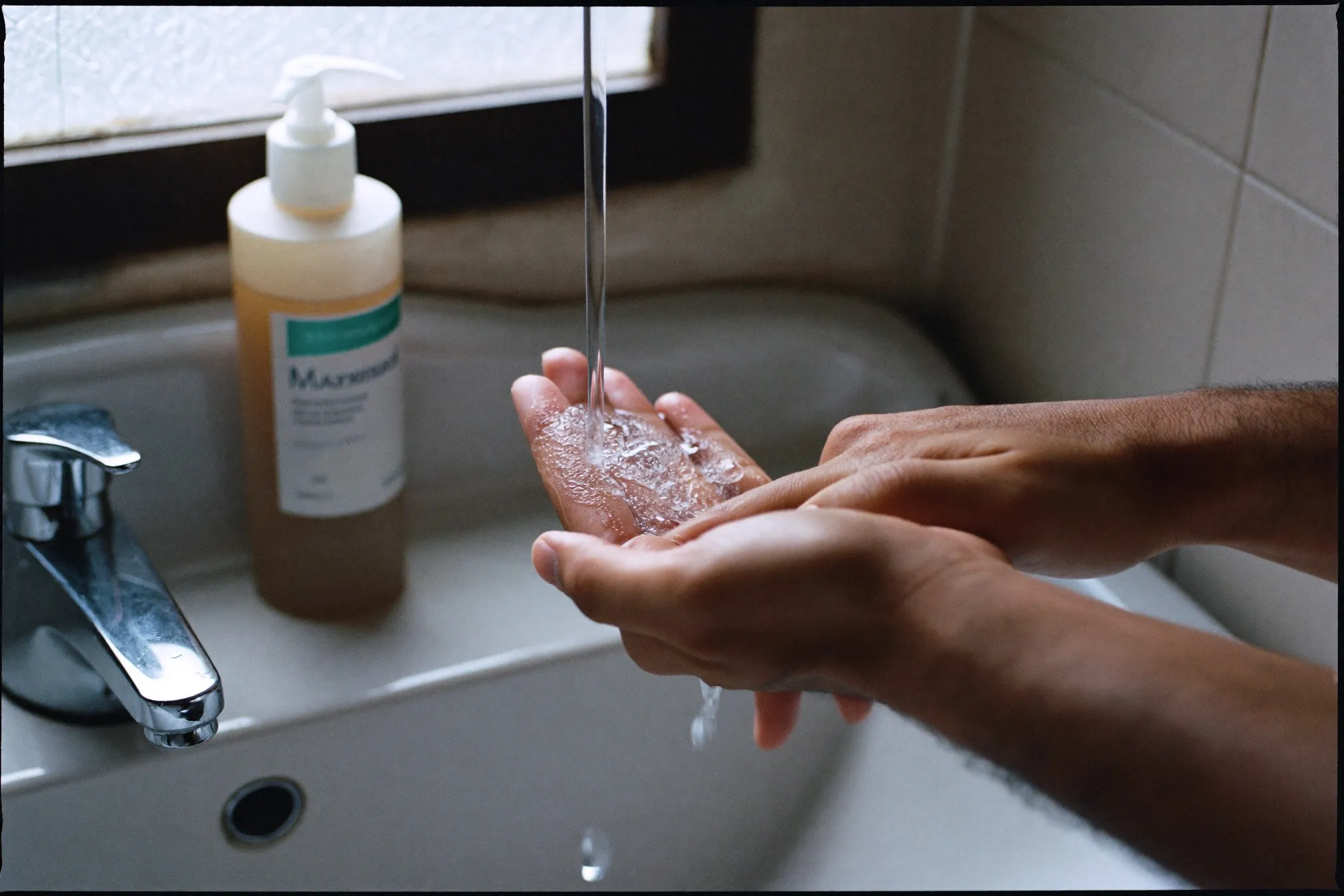
Is it oil, sweat or dehydrated skin?
Three different problems produce the same shine, and the fixes point in opposite directions. Get the diagnosis wrong and you will spend months making things worse with a stronger face wash. Match what you see in the mirror to the row below, then treat that.
| What you see | Likely cause | What to do |
|---|---|---|
| Shine on forehead and nose by midday | Normal sebum in a hot climate | Blot, light moisturiser, salicylic acid at night |
| Shine everywhere within an hour of washing | Over-stripping from a harsh cleanser | Switch to a gentle cleanser, cut the extra washes |
| Oily surface but tight and flaky underneath | Dehydrated skin, usually aircon plus over-washing | Keep moisturising, drop scrubs and alcohol toners |
| Greasy flaking in nose creases, brows or scalp | Possibly seborrhoeic dermatitis | See a GP or dermatologist |
That last row matters. Persistent greasy scaling with redness is a medical condition rather than a grooming problem, and MedlinePlus lists it among common skin conditions that a doctor treats. No face wash on the Watsons shelf resolves it.
What actually reduces oily skin?
Four ingredients carry the load. Salicylic acid and benzoyl peroxide both appear in the American Academy of Dermatology’s acne guidance, adapalene is a retinoid you can buy without a prescription in both markets, and niacinamide may help with shine and marks over several weeks. Everything else is optional.
| Ingredient | What it does | Typical price |
|---|---|---|
| Salicylic acid (BHA) | Oil-soluble, works inside the pore lining | RM30 to RM70 |
| Niacinamide | May reduce visible shine and post-spot marks over weeks | RM40 to RM90 |
| Adapalene | Retinoid that regulates cell turnover, useful for breakouts | RM40 to RM60 |
| Benzoyl peroxide | Targets acne bacteria, drying, so use it on spots | RM25 to RM45 |
| Clay (kaolin, bentonite) | Absorbs surface oil for a few hours, cosmetic only | RM20 to RM50 |
Start with one. Salicylic acid is the sensible first move for most oily faces: two or three nights a week, on clean skin, moisturiser after. Adding all five at once gives you irritated skin that produces oil and flakes simultaneously, which is a genuinely impressive outcome and not the one you wanted.
Prices above are shelf ranges at Watsons and Guardian. Shopee and Sephora sales cut them meaningfully, and the Korean and Japanese brands built for humid summers tend to sit at the lower end.
What does the routine look like day to day?
Two minutes in the morning, two at night, and no step you will abandon by Thursday. If you are building skincare from zero, our three-step routine for men covers the base. Oily skin adds one treatment and swaps the textures.
Morning. Gentle gel cleanser, splash of water, done. Lightweight moisturiser in a gel or fluid texture. Then sunscreen, because the WHO classifies ultraviolet radiation as a carcinogen and shine is not sun protection. A gel or “watery” SPF disappears in seconds and will not add to the problem.
Night. Cleanse properly, since a day of sebum, sunscreen and KL air needs more than water. Treatment on two or three nights. Moisturiser every night, including the oily ones.
After the gym or a sweaty commute. The AAD recommends washing your face after heavy sweating. A rinse with water in the office toilet counts. A second full cleanse with soap does not help and usually triggers the rebound shine you are trying to avoid.

What makes oily skin worse?
Most oily-skin damage is self-inflicted, and it comes from a reasonable instinct: the face feels greasy, so you attack it with something stronger. Harsh cleansers, alcohol toners and daily scrubbing all strip the barrier, and stripped skin responds by shining faster. The five habits below undo more than any serum fixes.
- Washing four or five times a day. Twice plus after sweating is the dermatology standard. Beyond that you strip the barrier and the shine returns faster.
- Bar soap on the face. It is built for skin that is not your face, and it leaves the barrier struggling.
- Alcohol-heavy toners. They deliver a satisfying squeaky finish and roughly forty minutes of matte before the rebound.
- Skipping moisturiser. Oil is not hydration. Dehydrated oily skin is the usual end state for men who have been fighting shine for years.
- Scrubs with grit. The AAD advises against abrasive scrubbing. On acne-prone skin it spreads inflammation and leaves marks.
Add one more that nobody lists: your phone screen. It spends the day on tables and in pockets, then sits against your cheek for a half-hour call. Wipe it.
How do you stay matte through a KL afternoon?
Managing the afternoon is separate from treating the skin. Blotting paper is the tool that does the job, costs almost nothing and requires no talent. A pack runs around RM10 at Watsons or roughly S$2 at Daiso, and it lives in your bag, not your bathroom.
Press, do not rub. Two sheets across the T-zone lifts the oil without disturbing your sunscreen. Oil-control powder works if you are going straight from the office to dinner, but keep it light, because a visible layer of powder on a sweaty face reads worse than shine.
If you reapply sunscreen during outdoor days, a mattifying gel formula handles both jobs. And take the cap or helmet off when you can. Trapped heat under a hatband is a reliable way to arrive somewhere with a shining forehead and a red line across it.
When should you see a GP or dermatologist?
Book an appointment if you have deep painful cysts, scarring or dark marks forming, or if a consistent routine has not shifted anything after about three months. The same applies to greasy flaking with redness, which may be a treatable condition rather than oily skin.
Both the AAD and Mayo Clinic note that prescription treatments exist well beyond what a pharmacy shelf offers, and doctors in MY and SG prescribe them routinely. A GP visit at a private clinic runs around RM60 to RM120, and a dermatologist consultation more. That is cheaper than two years of buying whichever cleanser Shopee shows you next.
Tonight, read the back of your current face wash. If it lists sodium lauryl sulfate near the top, menthol, alcohol denat or scrub beads, that bottle is part of the problem. Replace it with a gentle gel cleanser on your next Watsons or Guardian run and change nothing else for two weeks. Most men see the difference before they finish the bottle. For more on the rest of the routine, start at our skin hub.
Quick answers
How do I reduce oily skin permanently?
You cannot switch off oil production, because sebum output is set largely by genetics and hormones. You can lower how oily your face looks day to day with a gentle cleanser twice daily, a light moisturiser, and salicylic acid a few nights a week. Persistent, severe oiliness is worth a GP visit.
Does washing your face more often help oily skin?
No. The American Academy of Dermatology advises washing twice a day and after heavy sweating, using a gentle non-abrasive cleanser. Washing more than that strips the skin barrier, which usually leaves your face tight, irritated and shining again within the hour.
Should oily skin use moisturiser in this climate?
Yes, and a light gel or fluid texture is enough. Skipping moisturiser does not reduce oil. It tends to leave skin dehydrated on top of being oily, especially with all-day aircon, so you get shine and flaking at the same time.
Why is my face oilier in Malaysia or Singapore than overseas?
Heat and humidity add sweat that spreads sebum across your face, and skin tends to produce more oil in warm conditions. Your glands have not changed. The conditions have, which is why the same routine that worked on a holiday in Japan collapses by noon here.